Participation is a Gateway Activity
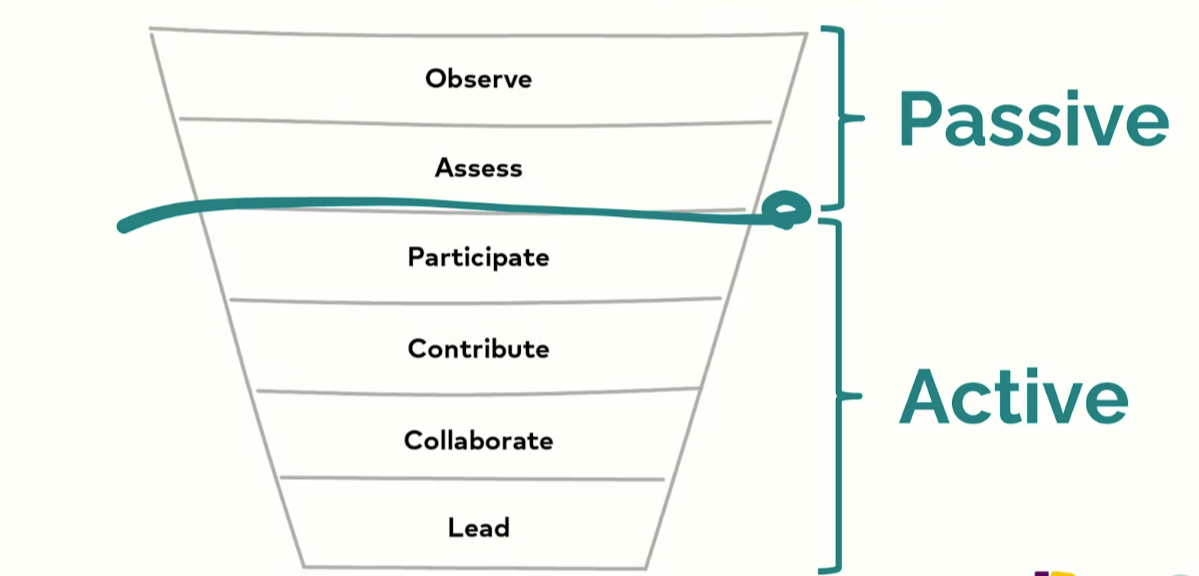
New members are like a stranger at a party. They’ve got their plate of cheesy, calorie-rich (but very tasty) apps, a sodden paper napkin balled in one hand, bleeding indigo onto their skin because it is smashed up against a sweating drink. They are standing on the outskirts of the action, watching. Other than some occasional munching, they are very passive. Standing there and taking it all in.
Our newest members are much the same. They read emails, they might watch a webinar, they might even come to an event, but tend to stay quiet while they observe.
People need a little time to get the lay of the land (the Observe stage). They need some time to figure out if our organization and community are for them (the Assess stage). But we don’t want them to stay locked in the passive stages for too long.
The longer people stay passive, the harder it is to participate. Have you ever been to a meeting and you know you should speak up? But you wait. And the longer you wait, the harder it is to break into the discussion with your thoughts?
Same, same for new members.
Take a look at the illustration above. There’s a natural psychological barrier between the passive and active stages. Participating is risky. What if they say something silly? What if the group has already covered this idea/issue/topic/question? What if the newcomer disrupts the group’s norms?
So, sometimes members need someone to open the door to participation for them.
Let’s practice solving common situations that throw up barriers to participation. Before going on to my answers, think about what works best for your organization.
The situation: A second-time chapter meeting attendee notices an opportunity to participate and even has an idea to contribute, but they don’t want to be the first in the group to do so. What could we do to make it easier for them to participate?
How could you solve this problem in your organization? Come up with one idea before scrolling down.
A few possible answers:
The host or speaker could provide an example answer to give participants a sense of what they are looking for.
Start a 1 or 2-minute timer to give people time to think and formulate an answer.
Designate a longer-time attendee to be the Head of Answering the First Question, which takes the pressure off everyone else and breaks the ice.
The situation: A new batch of people joins a Special Interest Group or Community of Practice. Soon, they sense tension around a hot topic. The leaders want to get everyone’s opinions, but realize that the newcomers might not want to weigh in.
What solutions are bubbling up for you?
A couple of possible answers:
Provide ways for people to share their thoughts, votes, and ideas anonymously. You can do this live with Mentimenter or asynchronously with Typeform.
Let people talk in small groups first. Talk to your neighbor, or hold roundtable-style discussions where people dive into subtopics.
The situation: You are running meetings for a chapter, council, committee, club, or community of practice, and there are dominant personalities, grandstanding, talking over others, interrupting, and monopolizing the conversation. (Cue sinking heart and tummy.) It makes people not want to participate.
A possible answer:
Work with all attendees or members to create rules of engagement, ground rules, or reverse ground rules (telling people what they can do instead of what they can’t)
What do you think?
What other doors can you open to invite more members to participate more often?